Introduction
Rotation defines how a playground Swivel Chair feels, responds, and engages users. When children sit and spin, their balance, confidence, and interaction change instantly. Different rotating structures create different experiences, from calm and controlled motion to energetic and social play. The way rotation is designed influences comfort, speed perception, and willingness to explore movement. In this article, you will discover how central-axis, offset, and multi-axis rotations shape user experience, helping designers, manufacturers, and planners make informed decisions for long-term play value.
Why Rotational Design Matters in a Playground Swivel Chair
Rotation as a Core Sensory Experience in Playground Swivel Chairs
Rotation stimulates the vestibular system, which supports balance and spatial awareness. In a playground Swivel Chair, smooth spinning creates a sense of flow that users quickly recognize and enjoy. If rotation feels consistent, children feel safe experimenting with speed and posture. When the structure responds clearly to body movement, they gain confidence and repeat play. This sensory loop explains why rotating equipment remains popular across age groups. It is not only movement; it is feedback that teaches users how their actions shape motion.
How Rotational Feedback Shapes Balance, Orientation, and Comfort
Rotational feedback tells users how their body aligns during motion. A well-designed playground Swivel Chair keeps rotation centered and predictable, helping children maintain orientation. When the chair rotates evenly, they can lean, shift weight, and recover balance easily. This supports longer play sessions without discomfort. Comfort grows when rotation feels stable rather than abrupt. Over time, users learn how to control spin speed and posture, which builds trust in the equipment and improves overall play satisfaction.
User Perception of Speed, Smoothness, and Control in Swivel Chairs
Users judge rotation by how smooth it feels and how easily speed changes. If rotation starts gently and accelerates steadily, they feel in control. A playground Swivel Chair that reacts instantly but smoothly feels responsive, not aggressive. This perception matters because children often compare spinning equipment by feel rather than appearance. Smooth rotation encourages repeat use, while controlled speed supports confidence. Together, these factors shape whether users see the chair as exciting, comfortable, and worth returning to.
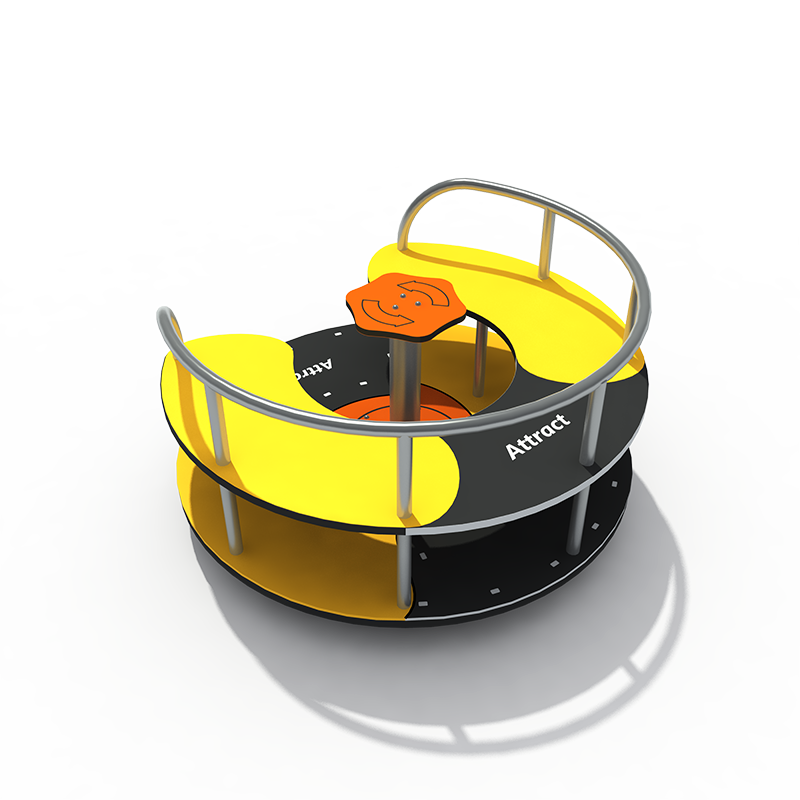
Central-Axis Rotating Structures and User Experience
Single-Point Axis Rotation and Its Effect on Motion Predictability
Central-axis rotation relies on one fixed vertical point. This design creates predictable circular motion that users quickly understand. In a playground Swivel Chair, this predictability supports confidence, especially for younger children. They know where the center is and how their body affects speed. Motion feels familiar and easy to manage. Because movement follows a clear path, users can focus on enjoyment rather than adjustment. Predictable rotation often leads to longer play cycles and calmer, more controlled spinning behavior.
How Central Bearings Influence Smoothness in a Playground Swivel Chair
Bearings are the hidden drivers of rotation quality. In central-axis systems, high-quality bearings reduce friction and vibration. This creates a smooth, quiet spin that feels refined. When friction stays consistent, users experience steady motion rather than jerks or pauses. A playground Swivel Chair with reliable bearings maintains the same feel over time, even with frequent use. This consistency builds trust and reinforces positive impressions, which is critical for public play spaces with heavy traffic.
User Confidence and Repeated Play with Central-Axis Swivel Chairs
Confidence grows when users feel safe and in control. Central-axis rotation supports this by offering stable, familiar movement. Children often return to equipment that feels reliable. They experiment with posture, speed, and social play without fear. Over time, repeated use strengthens coordination and comfort. From an operator perspective, central-axis playground Swivel Chair designs often show strong acceptance across age ranges, making them versatile choices for mixed-use playgrounds.
Multi-Axis and Offset Rotation in Playground Swivel Chairs
How Multi-Directional Rotation Changes Sensory Stimulation
Multi-axis rotation allows movement in more than one direction. This creates richer sensory input compared to simple circular motion. In a playground Swivel Chair, users feel subtle shifts in balance as rotation changes direction. This stimulates curiosity and encourages exploration. Children often describe this experience as more exciting because motion feels less predictable. Multi-directional rotation supports advanced vestibular engagement, which appeals to older or more adventurous users seeking novelty.
Offset Rotation and the Feeling of Dynamic Movement
Offset rotation changes how a Spinning Seat for Playground feels by shifting the rotation axis away from the user’s center of mass. This structural choice alters force distribution, perceived motion intensity, and engagement patterns. The breakdown below explains how offset rotation delivers dynamic movement while remaining controllable and suitable for public playground use.
| Dimension | Offset Rotation Characteristic | Practical Application in Spinning Seat for Playground | Technical Indicators / Reference Values |
| Rotation Axis Position | Axis is offset from seat center | Creates swinging and orbital sensation during spin | Typical offset distance: 150–300 mm from seat center |
| Centrifugal Force Sensation | Users feel outward pull more strongly | Enhances excitement without extreme speed | Centrifugal acceleration commonly 0.8–1.6 g at 15–25 rpm |
| Moment Arm Length | Increased distance from axis to user mass | Amplifies perceived momentum | Effective moment arm: 0.45–0.65 m (seat radius + offset) |
| User Body Feedback | Body experiences lateral and vertical cues | Encourages laughter and expressive reactions | Lateral displacement during rotation: ±50–120 mm |
| Speed Perception vs Actual Speed | Feels faster than central-axis designs | Allows lower rpm with higher thrill | Comparable thrill at 15 rpm offset vs ~22 rpm central-axis |
| Control Mechanism | Motion controlled by leaning and grip | Users regulate intensity intuitively | Typical handhold height: 800–1,000 mm for leverage |
| Structural Balance Requirement | Asymmetrical loading during use | Requires reinforced bearing housing | Dynamic load factor often designed at ≥1.5× static load |
| Bearing and Shaft Design | Higher radial load than centered systems | Ensures smooth operation under eccentric force | Radial bearing load ratings commonly 6–10 kN |
| User Age Appeal | Strong appeal to older children | Suitable for pre-teens seeking thrill | Common target age range: 6–12 years |
| Safety Zone Consideration | Wider perceived motion envelope | Requires clear surrounding space | Typical use zone radius: 1.8–2.2 m (EN 1176 guidance) |
Tip:Offset rotation works best when designers balance excitement with mechanical restraint. Selecting bearings rated for higher radial loads and limiting maximum rotational speed allows playground operators to deliver a dynamic experience while maintaining predictable motion and long-term durability.
Engagement Levels Compared to Traditional Playground Swivel Chair Designs
Compared to traditional central-axis designs, multi-axis and offset structures often generate higher engagement. Users spend more time experimenting with movement patterns. They invite peers to join, observe, and interact. While traditional playground Swivel Chair designs focus on stability, advanced rotation adds variety. This variety can reduce boredom and increase repeat visits. For designers, these structures offer a way to differentiate play zones and attract diverse user groups.
Rotating Resistance and Speed Control Mechanisms
Low-Resistance Rotation and the Feeling of Effortless Spinning
Low-resistance systems allow users to spin with minimal effort. This creates a light, floating sensation that feels playful and accessible. In a playground Swivel Chair, effortless spinning encourages younger children to participate without assistance. They can start motion easily and maintain it with small movements. This promotes independence and confidence. Low-resistance rotation also supports social play, as one child can easily spin another, creating shared experiences.
Progressive Resistance and Perceived Control in a Playground Swivel Chair
Progressive resistance increases friction as speed rises. This gives users a natural sense of control. When spinning faster requires more effort, children learn to regulate motion intuitively. In a playground Swivel Chair, this balance prevents sudden speed spikes while still allowing excitement. Users feel empowered because they control acceleration through body input. Progressive resistance often results in smoother transitions between slow and fast spinning, enhancing comfort and trust.
Matching Rotation Speed Profiles to Different User Preferences
Different users prefer different speed profiles. Younger children often enjoy slow, steady spins. Older users seek faster, more dynamic motion. By adjusting resistance and bearing design, manufacturers can tune speed behavior. A Spinning Seat for Playground with balanced speed control appeals to broader audiences. Matching rotation profiles to expected user groups helps align equipment performance with play goals, improving satisfaction and long-term value.
Single-User vs Multi-User Rotating Structures
Individual Control and Immersion in Single-User Playground Swivel Chairs
Single-user designs give full control to one person. This creates a focused, immersive experience. In a playground Swivel Chair, individual control allows users to explore speed and posture freely. They learn cause and effect through direct feedback. This type of play supports self-confidence and independent decision-making. Single-user structures often fit smaller spaces and provide quiet, concentrated engagement within busy playgrounds.
Shared Rotation and Social Interaction in Multi-User Designs
Multi-user rotating structures encourage cooperation. Users must communicate, push together, and adjust timing. In a Spinning Seat for Playground designed for groups, rotation becomes a social activity. Children laugh, negotiate, and coordinate movement. This shared experience builds social bonds and enhances enjoyment. Multi-user rotation also supports inclusive play, allowing users of different abilities to participate together.
How Cooperative Spinning Changes the Overall User Experience
When a playground Swivel Chair is designed for cooperative spinning, user experience shifts from solo motion to shared control. Group dynamics, physical forces, and communication all influence how the rotation feels. The following table breaks this interaction down into clear, practical dimensions relevant to design, selection, and deployment.
| Dimension | What Changes in Cooperative Spinning | Practical Application (Playground Use) | Technical Reference / Indicators |
| User Interaction Mode | Rotation is driven by multiple users instead of one | Encourages turn-taking, communication, and synchronized movement | Typical capacity: 2–4 users per unit (EN 1176-5 common range) |
| Force Input Distribution | Rotational force is shared across users | Reduces individual effort, enables younger or mixed-age users to participate | Combined tangential force often 150–300 N total, divided among users |
| Rotational Stability | Load symmetry becomes critical | Balanced seating layouts prevent wobble during group spinning | Recommended static load balance tolerance: ±10% per seat |
| Speed Regulation Behavior | Speed is moderated through group feedback | Users slow down or accelerate based on peer comfort | Observed rotational speeds typically 10–25 rpm for multi-user units |
| Social Feedback Loop | Visual and verbal cues guide motion | Eye contact and verbal signals replace mechanical control | Line-of-sight seating angles often 120°–180° between users |
| Safety Perception | Shared control increases perceived safety | Users feel supported and less likely to over-spin | Peak centrifugal acceleration usually kept below 1.5 g |
| Engagement Duration | Play sessions last longer | Group play sustains interest beyond solo spinning | Average dwell time increases by 30–50% vs single-user (field studies, EU playground audits) |
| Inclusivity Potential | Mixed abilities can contribute differently | Some users push, others ride or stabilize | Seat heights often 350–450 mm for assisted access |
| Mechanical Wear Pattern | Loads are more evenly distributed | Extends bearing and shaft service life | Axial load ratings commonly 8–12 kN for multi-user swivel bearings |
| Design Integration | Becomes a social anchor in play zones | Acts as a gathering point in open playground layouts | Typical safety zone radius: 1.5–2.0 m depending on diameter |
Tip:For B2B buyers, cooperative spinning designs perform best in community or school playgrounds where social play is a priority. Verifying bearing load ratings, balance tolerances, and tested rotational speed limits is essential to ensure smooth group interaction over long-term use.
Structural Stability and Its Impact on User Confidence
How Structural Balance Affects Trust in a Playground Swivel Chair
Structural balance is closely linked to how the human vestibular system interprets motion and risk. When the mass of a playground Swivel Chair is evenly distributed around the rotation axis, angular momentum stays predictable. This reduces unexpected lateral forces that trigger caution responses in children. A low center of gravity, combined with a rigid base connection, minimizes micro-movement at the foundation. These physical cues signal reliability, allowing users to trust the equipment almost instantly and engage without hesitation.
Perceived Stability During High-Speed Rotation
At higher rotational speeds, even small imbalances can amplify vibration and visual wobble. A well-balanced playground Swivel Chair maintains concentric rotation, preventing oscillation that the eye and inner ear detect as instability. Smooth high-speed performance depends on precise bearing alignment and controlled mass symmetry. When these conditions are met, users perceive speed as exciting rather than threatening. This perception encourages children to sustain faster spins while remaining relaxed and confident.
Emotional Comfort and Willingness to Experiment with Movement
Emotional comfort emerges when physical feedback remains consistent under changing postures. A structurally balanced playground Swivel Chair allows users to shift weight without altering rotation quality. This stability supports experimentation such as leaning outward or changing seating positions. Children interpret this reliability as freedom to explore movement safely. Over time, this leads to more creative play behaviors and longer engagement, as users feel empowered to test limits without fear of sudden loss of control.

Matching Rotating Structures to Intended User Experience Goals
Choosing Rotation Types for Calm, Focused Play Experiences
Calm play areas benefit from predictable rotation. Central-axis designs with moderate resistance support relaxed movement. In a playground Swivel Chair, this creates a soothing experience suitable for younger users or quiet zones. Such rotation encourages longer, gentle use rather than bursts of activity. Matching rotation to calm goals helps balance overall playground energy and supports diverse play styles.
Designing Playground Swivel Chairs for Energetic, Social Play
Energetic zones thrive on dynamic rotation. Multi-axis or offset designs add excitement and interaction. A Spinning Seat for Playground with responsive movement attracts groups and promotes active play. Faster acceleration and shared control create lively experiences. These designs often become landmarks within playgrounds, drawing attention and repeat visits from energetic users.
Aligning Rotational Structure Choices with Play Area Objectives
Every playground has goals, such as inclusion, activity level, or age focus. Rotational structure choice should support these aims. A playground Swivel Chair is not one-size-fits-all. Designers and buyers should align rotation behavior with expected users and environment. This alignment improves satisfaction, supports long-term engagement, and increases overall play value.
Conclusion
Different rotating structures directly shape comfort, control, and engagement in a playground Swivel Chair. Central-axis designs deliver predictable motion and user confidence, while multi-axis and offset systems add excitement and social interaction. Rotation resistance, stability, and user capacity further refine play quality and long-term value. By aligning rotation design with play goals, decision-makers can create safer and more engaging environments. Attract Playground Equipment Co., Ltd. offers well-engineered swivel chairs that balance performance, durability, and user experience for modern playgrounds.
FAQ
Q: What role does rotation play in a playground Swivel Chair experience?
A: Rotation defines balance, comfort, and engagement in a playground Swivel Chair, shaping how users feel motion and control during play.
Q: How do central-axis designs compare to offset designs?
A: Central-axis playground Swivel Chair designs feel predictable, while offset systems in a Spinning Seat for Playground add dynamic momentum and excitement.
Q: Why does rotational stability matter for user confidence?
A: Stable rotation helps a playground Swivel Chair feel safe, encouraging users to spin longer and explore movement with confidence.
Q: How does resistance affect a Spinning Seat for Playground?
A: Resistance controls speed and comfort, helping a playground Swivel Chair match calm or energetic play needs.
Q: Are multi-user playground Swivel Chairs more engaging?
A: Yes, multi-user designs turn a Spinning Seat for Playground into a social activity, increasing interaction and repeat play.


